What we do
We build the software a city already pays for — so it owns it instead.
A city of eighty thousand rents its website from one company, its bus routing from another, its board packet from a third and its text alerts from a fourth. None of them share a record, so the city pays four times to store the same resident's name four times — and still cannot tell that resident where the crew is. We build all of it as one platform the institution owns outright: the source, the data and the keys.
The full picture of what we do lives at www.civq.us (opens in a new tab).
- 9unsolicited proposals, built and live
- 1,228pages, every one in two languages
- 0accessibility violations across them
Read this first
None of the nine institutions below asked us to build these. Nobody hired us, nobody paid for them, and none of them has endorsed this. We built them on our own initiative, in public, so that what we can do could be looked at instead of described — and so that a conversation with a city could start from something working rather than from a slide deck and a promise.
That is also why every one of them carries a banner at the top of every page saying it is not that institution's website. These are proposals addressed to them, built with their real public identity and clearly-labelled demonstration data. If any institution would prefer its build taken down, we will take it down.
How we work
Everything is custom. These nine are examples, not a catalogue.
We do not sell a product with your name put on the front of it. Every one of the builds below started from what that institution actually does — its own departments, its own record, its own geography, its own two languages — and was built to fit it. Nothing here is a template that nine clients share.
So the list is not a menu. If the thing you need is not on it, that is not a limitation — it is simply something we have not been asked for yet. A permit workflow, a court docket, a grant tracker, a water-quality report, an inspection route, a payroll interface, a public dashboard for a bond programme: it is all software, and it is all built the same careful way.
What is fixed is not the feature list — it is the standard. Both languages written rather than machine-translated. Accessibility checked on every page before it is allowed to publish. The institution owns the source, the data and the keys. Everything else is a conversation about what you want to see.
And we build it before you buy it. Each of the nine below is a working proposal, not a slide: the real institution, built out far enough to be used and argued with rather than described. That is how we would rather start with you too.
Why this saves the taxpayer money
Rent is forever. A licence renewed every year for a website, again for the agenda portal, again for the notification service and again for the routing system is a permanent line in a budget that never buys anything the public owns at the end of it. Build it once and the institution has an asset instead of a subscription.
An accessibility audit is a second bill for the same problem. It tells a city what is wrong after it has already paid to build it wrong, and then the remediation is a third bill. Checking conformance on every build costs nothing per year and removes both.
The expensive failures are the invisible ones. A truck that was never told it needed brakes. Eleven days of a rented sewer jetter because nobody could see that a part was on order. A resident who telephones three times because no screen could tell them a crew was already scheduled. Every one of those is a number that did not exist until it had somewhere to live.
And it is local. We are in Rio Grande City. The person who answers the phone has driven the roads on these maps, and both languages on every one of these builds are written rather than machine-translated, because most of the people they serve read Spanish first.
What we build
Each of these is running in at least one of the builds below, and the links open the live thing rather than a screenshot of it. It is a sample of what has been asked for so far, not the list of what can be built.
-
Agendas and minutes, published as text
This is the one every board asks about, so here is what it looks like in four different institutions. Every item, every motion, who moved it, who seconded it, and how each member voted by name. The conflict-of-interest recusal with the affidavit behind it. The closed session with its citation. The split vote with the dissent explained in the dissenter's own words. It is searchable, translatable, readable by a screen reader, and it prints — none of which is true of a scanned PDF inside a viewer.
See it running:
-
Fleet GPS and preventive maintenance
Every vehicle on a real map of the actual place, what it is doing, and which ones cannot legally be driven tomorrow morning. Behind it the service queue, on whichever trigger comes first — miles, engine hours or the calendar. A stale position sits at its last confirmed fix with the time printed on it, because a map that guesses is worse than no map.
See it running:
-
Apps for residents and for the people who do the work
The person who reports the pothole and the crew who fill it look at the same record from two ends. The parent asking where the bus is and the driver running the route. The patient and the nurse. One system, two screens — and the staff screen never shows a name that a stranger could read over a shoulder.
See it running:
-
Dashboards the people inside actually use
A city manager at 7:30 with coffee, a supervisor in the yard at six on a phone, and the clerk at the window. Different screens, because they are different jobs. Every tile links to the list that produced the number, and no screen shows personal information it does not need.
See it running:
-
Accessibility built in, not audited afterwards
An accessibility audit is a bill for a problem a different build would not have had. Here the colour contrast is checked before a page is generated, every generated page is checked for headings, labels, alt text and broken links, and the build refuses to publish if any page fails. The result is WCAG 2.2 AA on every page, verified with the same engine most paid audits run underneath.
See it running:
What we run
Our own software, live on its own domains, and one nonprofit we are building. These are not proposals and nobody's identity is borrowed for them — they are the things we are actually responsible for. Three of the four are unfinished, and each says so on its own front page rather than here.
-
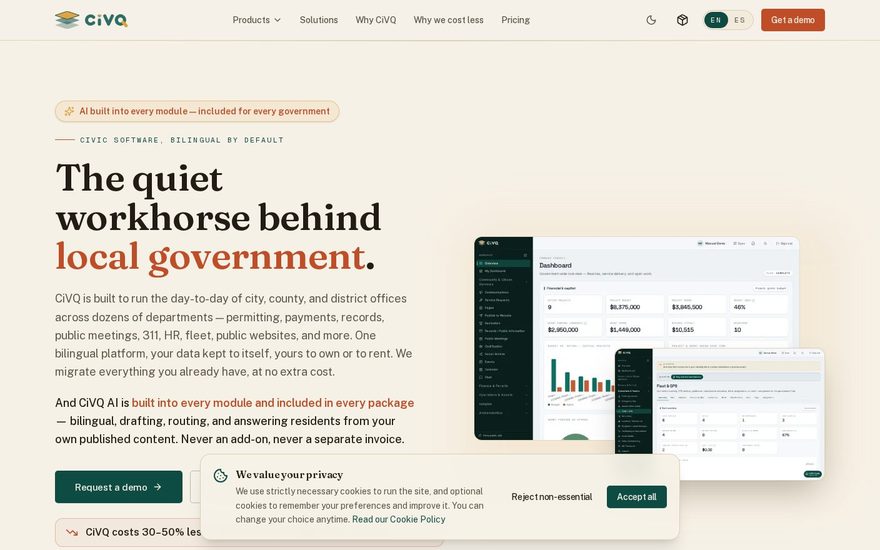
Civic platform · live
CiVQ (opens in a new tab)
One bilingual platform for the day-to-day of a city, county or district — permitting, payments, records, public meetings, 311, HR, fleet and the public website. Your data kept to itself, and yours to own rather than rent. Migration from whatever you run today is included.
Note: The product the nine builds below are arguing for.
-
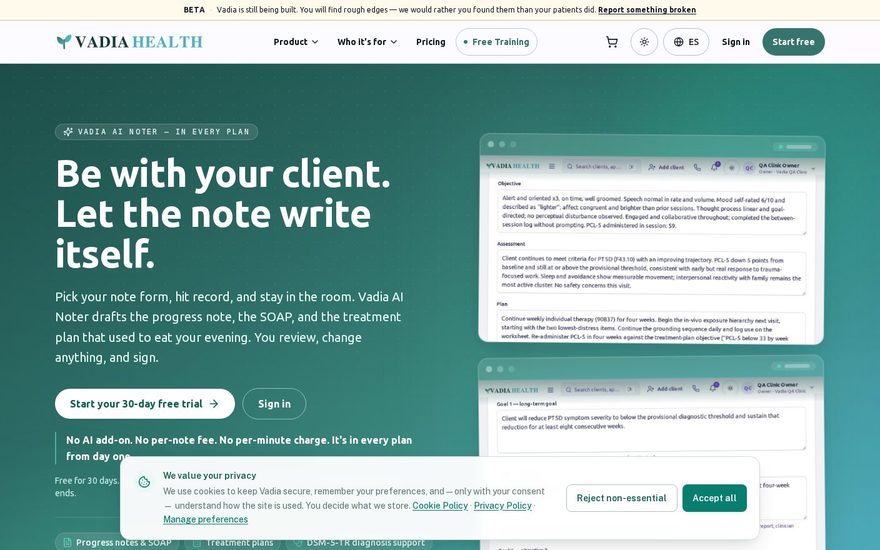
Behavioral health EHR · beta
Vadia Health (opens in a new tab)
A bilingual, multi-tenant behavioral and mental health EHR and practice-management platform: scheduling, documentation, telehealth and an English/Spanish client portal. Its AI Noter drafts the progress note, the SOAP and the treatment plan from the session so the clinician can stay in the room — in every plan, with no per-note or per-minute fee.
Note: In beta, and says so on its own front page.
-
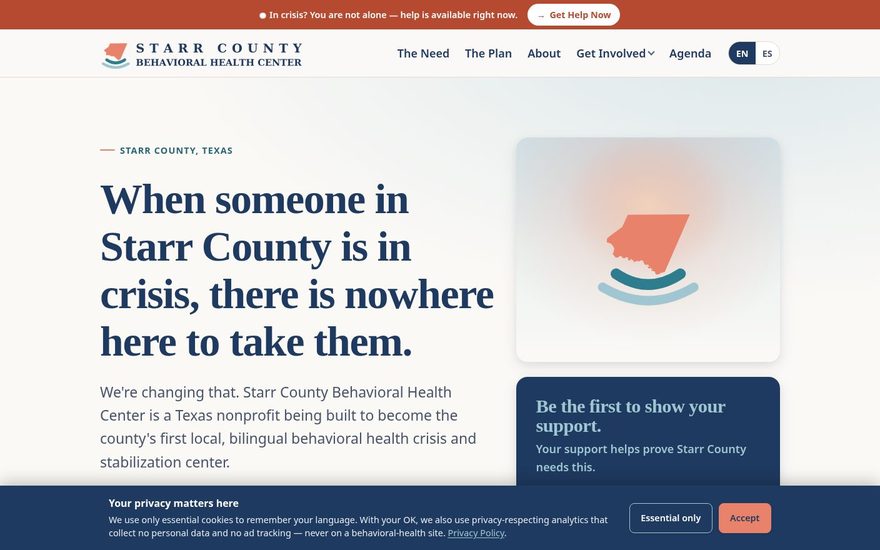
Texas nonprofit · being built
Starr County Behavioral Health Center (opens in a new tab)
When someone in Starr County is in crisis there is nowhere in the county to take them — no psychiatric hospital, no crisis stabilization unit, no diversion centre. This is the nonprofit being built to become the county's first local, bilingual crisis and stabilization centre, and the site says plainly that it does not exist yet.
Note: Every page leads with 988 and 911, above the fundraising.
-
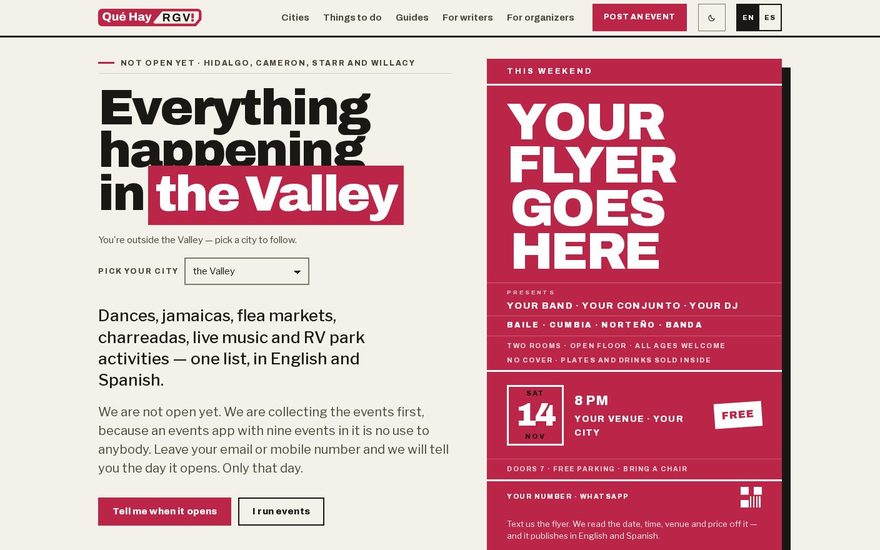
Bilingual events platform · collecting
Qué Hay RGV (opens in a new tab)
The bilingual events calendar for the Rio Grande Valley — dances, jamaicas, flea markets, charreadas, live music and RV park activities across Hidalgo, Cameron, Starr and Willacy counties, in one list, in both languages.
Note: Not open yet: it is collecting events first, because a calendar with nine events in it is no use to anybody.
The work
Nine institutions, all in the Rio Grande Valley, and nine different briefs — five cities, a county hospital and two school districts each wanted something different, so each got something different. Every build uses that institution's real identity, with demonstration data everywhere a real record would be, and every page that shows one says so.
-
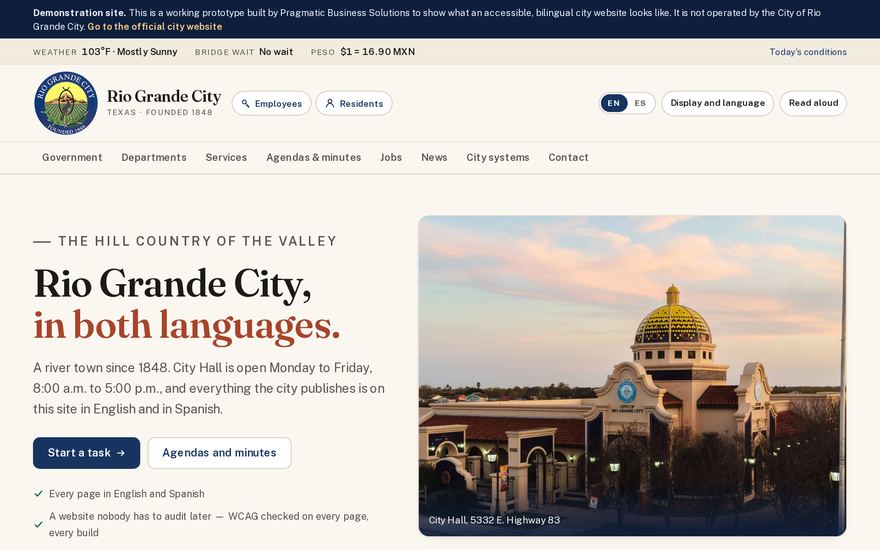
City · population 15,317
City of Rio Grande City (opens in a new tab)
The whole city, rebuilt: 824 pages in English and Spanish, thirty-one modules the city would own instead of renting from nine vendors, a live fleet map, staff dashboards, and one meeting published as text with every roll-call vote.
Built: 824 pages · agendas and minutes · fleet GPS · dashboards · resident and staff apps
Replaces: Nine separate vendor systems, and agendas published as photographs of paper.
-
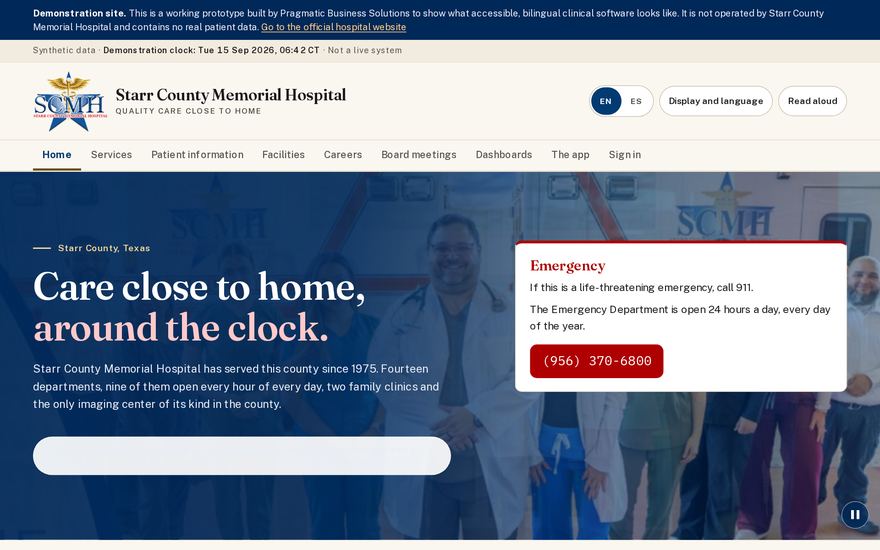
Hospital · county-owned
Starr County Memorial Hospital (opens in a new tab)
A county hospital's public site and the clinical screens behind it: the board record from the hospital's own published minutes, role dashboards, and an app for patients that shows results, the next visit and the live emergency wait.
Built: 46 pages · board minutes from the real record · role dashboards · patient and care-team apps
Replaces: A site where the board record was hard to read and the patient had no screen at all.
-
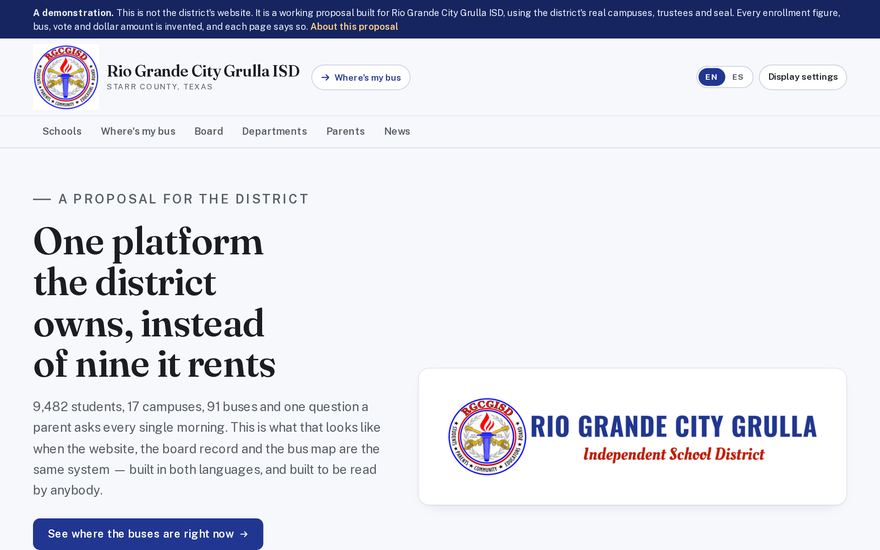
School district · 9,482 students
Rio Grande City Grulla ISD (opens in a new tab)
The district's site rebuilt while its own domain was down, plus the thing every parent asks for: a live map of where the buses are, and a phone screen that answers it with one number.
Built: 108 pages · all 17 campuses · board agendas with recorded votes · live bus map · parent and driver apps
Replaces: A rented CMS, agendas as scans, and no way to tell a parent where the bus is.
-
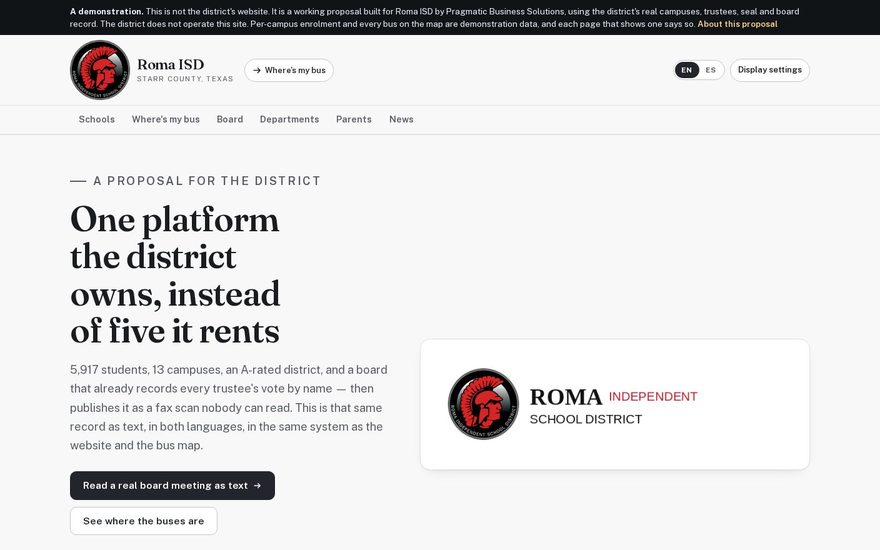
School district · 5,917 students
Roma ISD (opens in a new tab)
This district already records how every trustee voted, by name, on every motion — Texas law does not ask it to — and then publishes it as a 200-dpi fax scan with no text in it. We recovered three of those meetings and published them as words, in both languages.
Built: 116 pages · 505 meetings indexed, 3 published in full · 31 real roll-call votes · all 13 campuses with principals and ratings · live bus map · parent and driver apps
Replaces: A rented CMS, a separate site per campus, the board record on a second vendor, and minutes no screen reader can read.
-
City · population 79,715
City of Pharr (opens in a new tab)
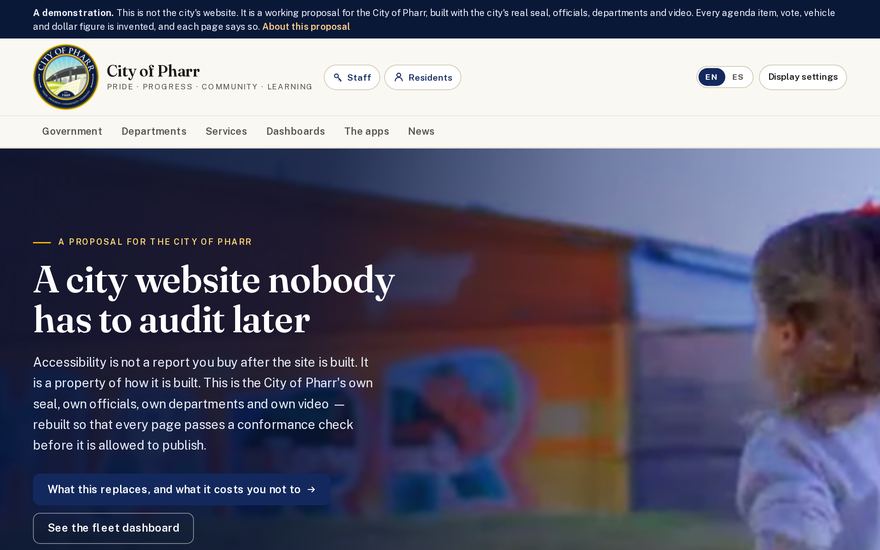
Built against a measurement rather than an opinion: their own site was tested first, and this one answers it. Same hero footage, one fiftieth of the weight, and zero accessibility violations across every page.
Built: 124 pages · commission record · fleet GPS and maintenance · four dashboards · resident and crew apps
Replaces: A front page of 85 MB, and the public record inside a document viewer with 100 failing elements.
-
City · population 85,778
City of Mission (opens in a new tab)
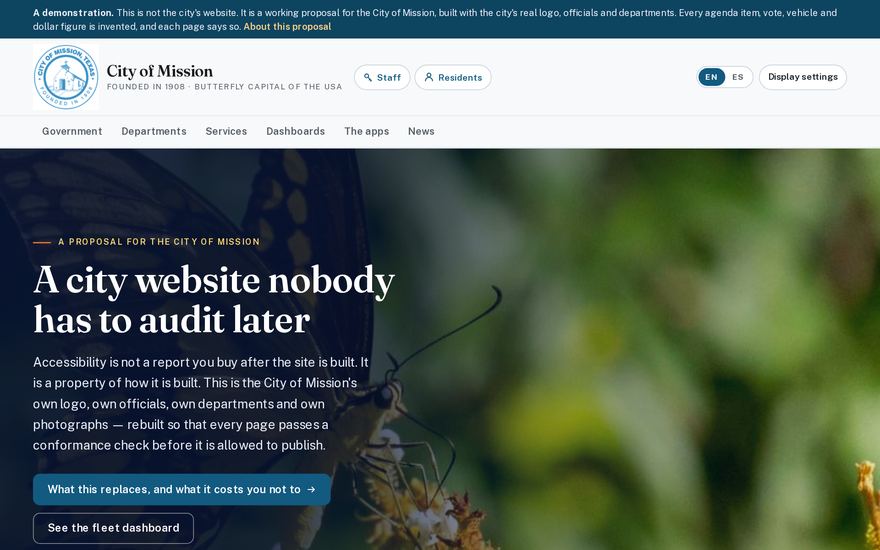
The city's own logo, officials, departments and photographs — the butterflies it is named for on the front page at a quarter of a megabyte, against the twenty-six their current front page ships.
Built: 126 pages · council record · fleet GPS and maintenance · four dashboards · resident and crew apps
Replaces: A critical accessibility fault in the main menu, repeated on every interior page.
-
City · county seat · population 100,243
City of Edinburg (opens in a new tab)
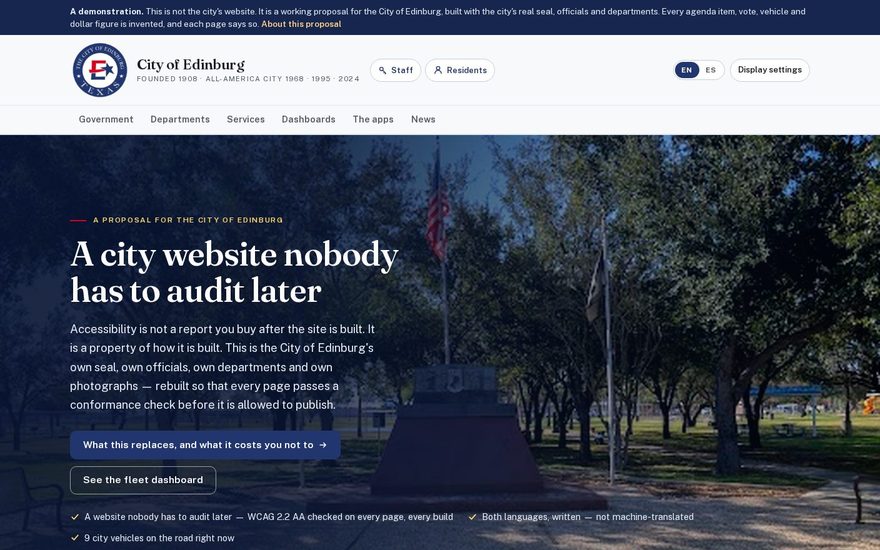
Their front page downloads 22.9 MB, 21.6 of it pictures — and forty of those sixty-eight pictures are event posters with the date, the hour and the address set as pixels inside them, drawn as CSS backgrounds that cannot carry alternative text at all. The page already loads twelve third-party hosts, two of them selling accessibility.
Built: 146 pages · six of the city's own notices republished as text · council record with recorded votes · fleet GPS on geocoded real addresses · four dashboards · resident and crew apps
Replaces: An accessibility overlay and a document-accessibility service, bought from outside, neither able to reach the forty posters.
-
City · population 43,864
City of Weslaco (opens in a new tab)
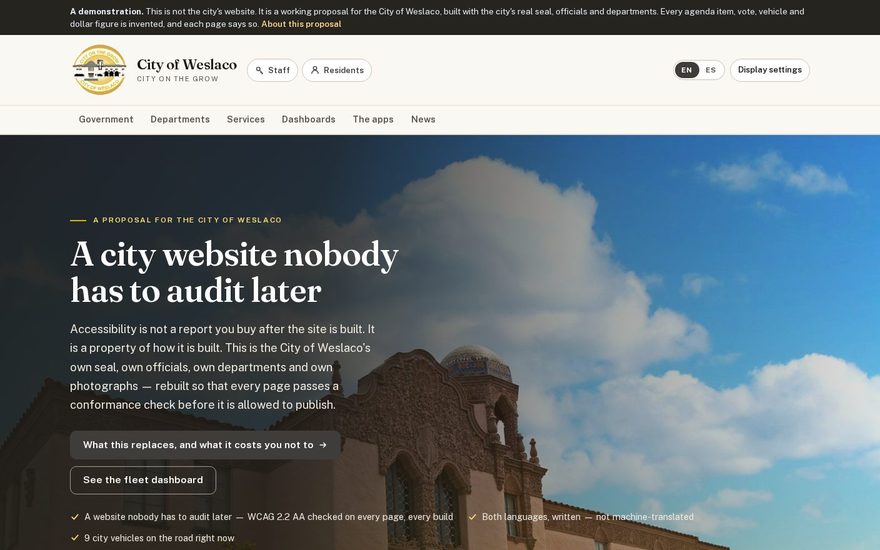
Their logo is a 4096-pixel PNG weighing 4.8 MB, shown ninety pixels tall — and the footer loads the identical file again, so every page carries 9.7 MB of the same picture. It is why their departments index, a page that is a list of links, weighs 11 MB. Every interior page also switches off pinch-zoom, which the home page does not.
Built: 152 pages · six of the city's own notices republished as text · commission record with the districts the city itself publishes · fleet GPS · four dashboards · resident and crew apps
Replaces: A 24 MB parks page, a 14 MB animated GIF, and a YouTube player behind the front page.
-
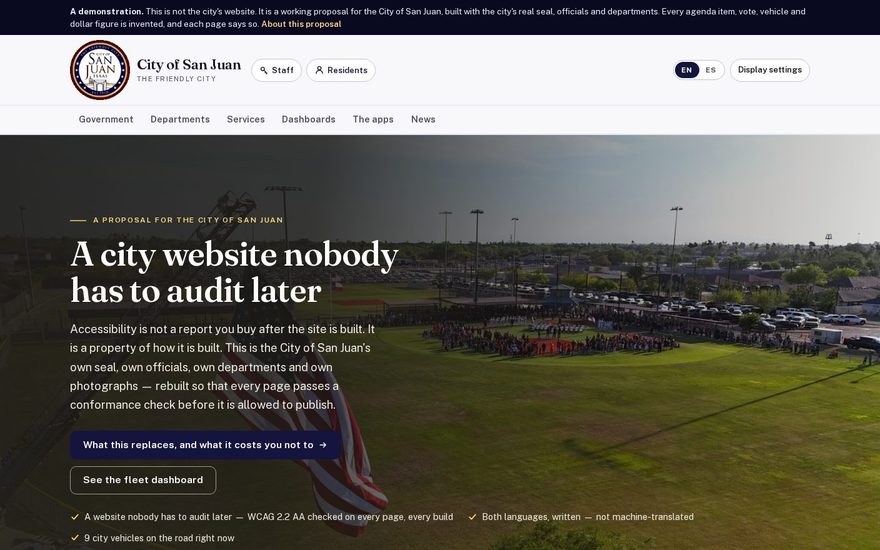
City · population 36,448
City of San Juan (opens in a new tab)
Their Frequently Asked Questions page answers ten questions, and eight of those answers end in a link. Four of the eight do not reach what they promise: two point at a bare IP address that does not respond — one of them is the answer to “How can I sign up for emergency alerts?” — one 404s, and one has the domain typed into the path. Their Human Resources page links to 192.168.1.13, an office address no resident can reach.
Built: 110 pages · six of the city's own notices republished as text · commission record with the places the city itself publishes · fleet GPS · four dashboards · resident and crew apps
Replaces: Fifteen separate vendor systems for residents and eleven more for staff — plus a paid accessibility overlay that cannot read the posters the news is published as.
-
Next
Your city, district or hospital
Whatever it is you need built. The nine above are examples of what this looks like, not the limit of it — each one was shaped by what that institution wanted to see, and yours would be shaped by what you want to see. We would rather show you one for your own than talk about somebody else's.
Talk to us: info@pragmaticsolutions.app
Everything else: www.civq.us (opens in a new tab)
What is real in these, and what is not
Unsolicited. None of these nine was commissioned. No institution below has hired us, paid us, reviewed this work or endorsed it. Each build is an unsolicited proposal we made on our own initiative and published so it could be examined.
Real: every institution's name, seal, officials, departments and geography, the statutes cited on the meeting pages, and every accessibility measurement quoted about a live site. Invented: every agenda item, motion, recorded vote, dollar figure, vehicle position, service request and maintenance record. These are proposals, not the institutions' own websites, and each one says so at the top of every page.